
Biliary Atresia Treatment in Delhi
Biliary atresia treatment in Delhi begins with an early, accurate diagnosis so the Kasai procedure can be done in the first two months of life. If bile flow does not recover, a liver transplant can save your child’s life. At IHPBLT in Delhi, Dr. Abhideep Chaudhary and his team guide families through both stages, from the first consultation to long-term follow-up.
What Is Biliary Atresia?
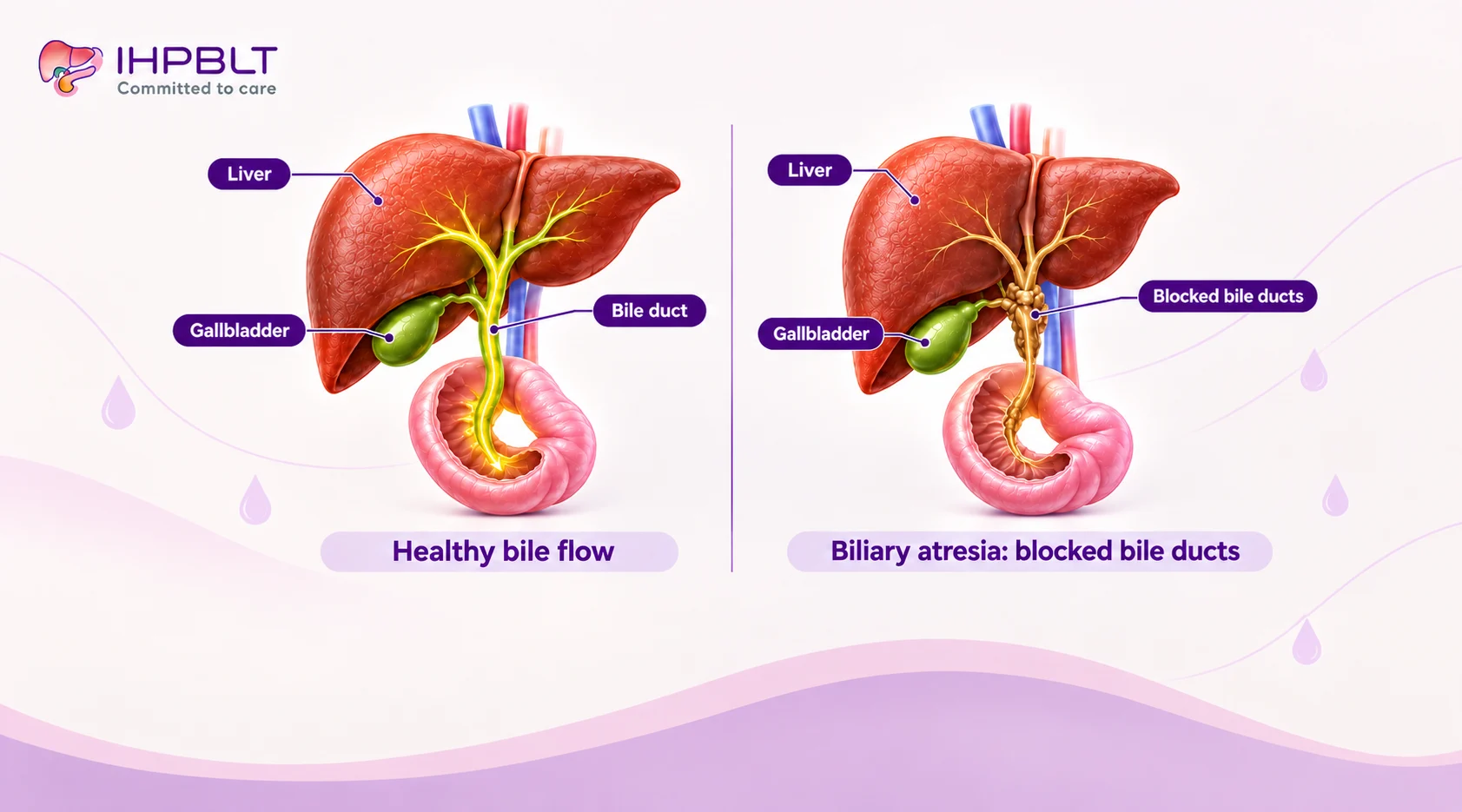
Biliary atresia is a rare liver condition in newborns in which the bile ducts are blocked or missing. Bile cannot reach the intestine, so it builds up and scars the liver. Left untreated, it usually leads to liver failure within the first two years of life.
- It affects roughly 1 in 8,000 to 20,000 live births, according to GIKids (a paediatric gastroenterology resource).
- Most babies are born full term and look healthy at birth, which is why early signs are easy to miss.
- The exact cause is still unknown. It is not caused by anything a parent did, and it is not contagious.
- Biliary atresia is the most common reason children need a liver transplant, accounting for over half of paediatric transplants in most published series (Seminars in Liver Disease, 1998).
Knowing that this condition is rare, not your fault, and treatable when caught in time helps families act quickly and without guilt.
Biliary Atresia Symptoms in Newborns
Biliary Atresia’s main sign is jaundice (yellow skin and eyes) that lasts beyond two weeks of age, along with pale, clay-coloured stools and dark urine. A baby with these signs should see a paediatric liver specialist at once, even if feeding and activity seem normal.
- Yellow skin or eyes that persist after the second week of life. Normal newborn jaundice settles by then.
- Pale, grey, white or clay-coloured stools instead of the usual yellow or green.
- Dark yellow urine that stains the nappy.
- A swollen belly or an enlarged liver, noticed by the doctor.
- Slow weight gain, irritability or poor feeding as the liver damage progresses.
Take a clear photo of your baby’s stool in daylight and show it to your paediatrician. It can speed up referral by days.
Reach Out for Expert Care
Biliary Atresia Treatment Pathway in Delhi
Biliary atresia is treated with surgery, not medicines alone. Most babies first have the Kasai procedure to restore bile flow. If the liver is already badly scarred, or bile flow does not improve, a liver transplant is the next step.
- Diagnosis first: Blood tests (including bilirubin), an abdominal ultrasound and sometimes a liver biopsy or a special bile-duct imaging study help confirm biliary atresia and rule out other causes of newborn jaundice.
- Kasai procedure: This is the first-line surgery for most infants. It connects the baby’s own intestine to the liver so bile can drain. It works best when done early, ideally before 60 days of life.
- Monitoring and nutrition: After surgery, the team tracks how well jaundice clears and watches for infections. Medicines support bile flow, and a high-calorie feeding plan with vitamin supplements helps the baby grow.
- Liver transplant: This is advised if jaundice persists after Kasai, if complications such as portal hypertension develop, or if the baby arrives with advanced scarring. A parent can often donate part of their liver.
- Not every child follows the same path: Some babies need only the Kasai procedure for years. Others need a transplant sooner. Regular follow-up shows which route your child needs.
Both stages are planned together, so your child is never left without a next option. You can read more about our approach to bile duct surgery in Delhi and our paediatric liver transplant programme.
What Is the Kasai Procedure and When Should It Be Done?
The Kasai procedure (hepatoportoenterostomy) connects a loop of your baby’s own small intestine directly to the liver, replacing the blocked bile ducts so bile can drain. It works best when performed before 60 days of age.
- How it works: The damaged ducts are removed and the intestine is attached to the liver surface. The surgery is done under general anaesthesia, followed by close monitoring.
- Why timing matters: In a long-term study published in Pediatric Surgery International (2013), surgery before 60 days and quick normalisation of bilirubin were independent predictors of keeping the native liver.
- Late presentation: A 2021 study in the Journal of International Medical Research suggests babies seen between 60 and 90 days should still be referred, provided the liver has not yet decompensated.
- Not a cure for everyone: According to the American Liver Foundation, the surgery works for about two-thirds of babies, who then avoid a transplant in infancy, though many still need one later in childhood.
- After surgery: Antibiotics for infections, medicines to support bile flow and a high-calorie feeding plan are the foundation of recovery.
Every week counts, so do not wait for symptoms to “settle on their own.”
When Does a Child With Biliary Atresia Need a Liver Transplant?
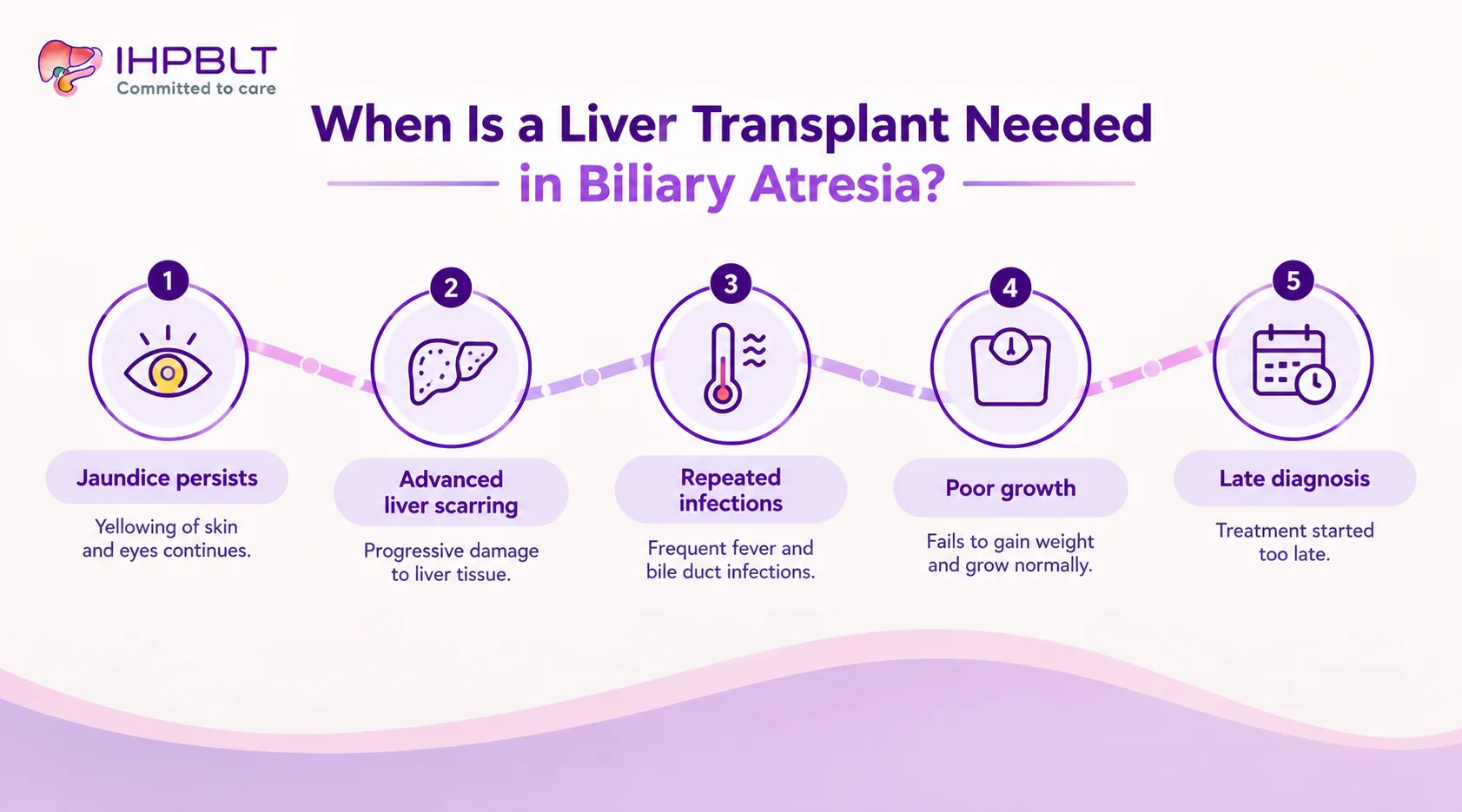
A child needs a liver transplant when the Kasai procedure fails to restore bile flow, when liver scarring (cirrhosis) keeps progressing, or when the diagnosis comes too late for Kasai. It is the definitive treatment once the liver can no longer function safely.
Long-term data from UCSF’s paediatric liver centre suggest about 4 in 5 children with biliary atresia will need a transplant before age 20.
Our paediatric liver transplant programme in Delhi evaluates infants and children early, so the decision is planned rather than rushed. The same team also performs liver transplant for adults.
Can a Parent Donate a Liver for a Child With Biliary Atresia?
Yes, a healthy parent or close relative can donate a small portion of their liver in a living donor liver transplant. The liver regrows in both donor and child, and surgery can be scheduled instead of waiting for a deceased donor.
- The donor is first checked for blood group match, overall health and liver size. Donor safety always comes first.
- Only a small part of the liver is needed for an infant.
- Deceased donor and split-liver transplants are alternative routes when no suitable family donor is available.
- Living donor transplants in India require approval from an authorisation committee under transplant law, and our team guides families through the paperwork.
Any parent considering donation deserves unhurried counselling, and that is part of our evaluation.
Reach Out for Expert Care
Biliary Atresia Treatment Success Rate
With Kasai surgery followed by a transplant when needed, most children with biliary atresia now live into adulthood. One long-term study reported 94.9% overall 10-year survival when transplant was available, even though only 39% of children kept their own liver.
- According to GIKids, about 90% of children with biliary atresia are alive 10 years after a liver transplant.
- The OPTN/SRTR 2024 Annual Data Report shows 95.7% patient survival and 93.9% graft survival at 12 months for paediatric deceased-donor liver transplants.
- Without any surgery, median survival is only about 8 months (Seminars in Liver Disease, 1998).
- Outcomes depend on age at Kasai, how well jaundice clears, infection control, nutrition and regular follow-up.
Results vary by centre, so always ask a transplant team about its own paediatric experience before you decide.
How Much Does Biliary Atresia Treatment Cost in India?
The Biliary Atresia treatment cost depends on whether your child needs the Kasai procedure, a liver transplant or both, along with ICU stay, donor type, medicines and follow-up. An accurate estimate is possible only after your child’s evaluation and review of reports.
- Kasai surgery and a liver transplant are very different in scope and cost.
- Living and deceased donor transplants have different hospital and donor-related expenses.
- Post-transplant medicines and follow-up visits are an ongoing cost.
- See our liver transplant cost guide for the factors that shape the final estimate.
We share a transparent estimate after consultation, so there are no surprises later.
Why Choose IHPBLT for Biliary Atresia Treatment in Delhi?
IHPBLT, led by Dr. Abhideep Chaudhary, provides paediatric liver transplant and complex bile duct care in Delhi at BLK-Max Hospital, Rajendra Place and Max Super Speciality Hospital, Dwarka. The team has performed over 2,000 liver transplants.
- Dr. Abhideep Chaudhary is an internationally trained liver transplant surgeon with 20+ years of experience. Read his full profile.
- A multidisciplinary team supports your child from evaluation to surgery, ICU recovery and lifelong follow-up.
- Families from abroad can find travel and visa guidance on our international patients page.
- Treatment plans are explained in plain language, with every option discussed openly.
A first consultation is the safest way to understand your child’s specific situation.
Medical disclaimer: This page is for information and does not replace a doctor’s advice.
Frequently Asked Questions
Is biliary atresia curable? expand_more
The Kasai procedure can restore bile flow, and a liver transplant is the definitive treatment when it fails. With timely care, most children grow up healthy.
At what age should the Kasai procedure be done? expand_more
Ideally before 60 days of life. Babies who present later should still be assessed, as some benefit up to about 90 days.
Can biliary atresia be detected before birth? expand_more
Usually not. It is typically recognised in the first weeks after birth through persistent jaundice and pale stools.
Which doctor treats biliary atresia in Delhi? expand_more
Care involves a paediatric liver specialist, a paediatric or HPB surgeon and a liver transplant surgeon working together.
Can my child live a normal life after a liver transplant? expand_more
Yes. Most children return to school, play and normal growth, with daily anti-rejection medicines and regular check-ups. See our FAQs for more.

Medically Reviewed by:
The IHPBLT Medical Editorial Team
 WhatsApp