

MELD Score Explained: Minimum Score for Liver Transplant
If your doctor has mentioned a MELD score, you are probably wondering what the number means, how high is too high, and whether it decides if you need a liver transplant. This guide explains the MELD score in simple words, including the minimum MELD score for liver transplant, what MELD 3.0 changed, and how it works for patients in India.
What Is a MELD Score?
The MELD score (Model for End-Stage Liver Disease) is a number between 6 and 40 that shows how severe your liver disease is and how urgently you may need a liver transplant. A higher score means a higher risk over the next three months.
- It is worked out from simple blood tests, not from a scan or biopsy.
- It was first designed to predict survival after a liver shunt procedure called TIPS, and later became the standard way to rank patients waiting for a liver.
- It is used for adults and children aged 12 and above. Younger children are scored with PELD.
The MELD score gives your transplant team one clear number to track, so treatment decisions are not based on guesswork.
How Is the MELD Score Calculated?
Your MELD score is calculated from a handful of blood test results: bilirubin, INR and creatinine, with sodium and albumin added in the newer versions. You do not need to do the maths yourself, as your doctor or a MELD score calculator does it for you.
- Bilirubin: shows how well the liver clears bile pigment. High levels cause jaundice.
- INR: shows how well your blood clots, which depends on the liver.
- Creatinine: shows kidney function. Liver and kidney problems often go hand in hand. If you are on dialysis, this value is set to its maximum.
- Sodium and albumin: low levels point to more advanced cirrhosis.
Since the score depends on lab values, it can change with every new set of tests.
MELD vs MELD-Na vs MELD 3.0: What Is the Difference?
MELD uses three blood tests. MELD-Na (adopted in the US in 2016) adds sodium. MELD 3.0 adds albumin and female sex and was adopted by the US transplant network in July 2023. All three aim to predict who is most at risk without a transplant.
- MELD 3.0 also lowers the creatinine cap from 4.0 to 3.0 mg/dL.
- Women were found to be less likely to receive a transplant, so MELD 3.0 adds 1.33 points for female sex (MDedge).
- After the change, women’s share of US liver transplants rose from 37.3% to 42.1% (same source).
- In India, the version used can differ between hospitals, so ask your team which one they follow.
A newer version is more accurate for more patients, but the basic idea stays the same: higher score, higher urgency.
What Is a Good MELD Score?
A lower MELD score is better. Below 10 suggests mild disease, 10 to 19 is moderate, 20 to 29 is serious, 30 to 39 is severe, and 40 or above is critical. In the original study of hospitalised patients, three-month mortality rose from about 2% below 10 to 71% at 40 or above (MSD Manual).
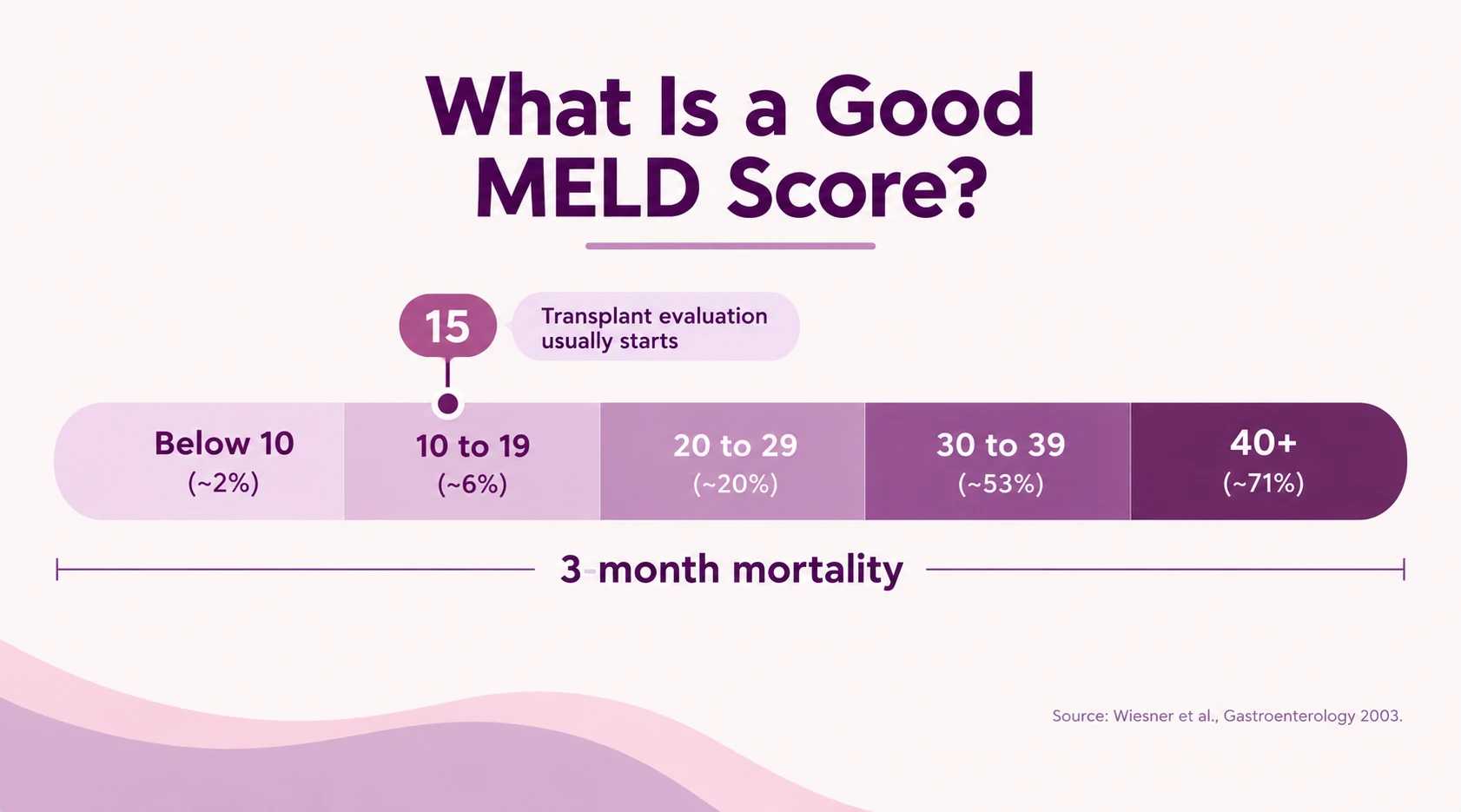
- These figures are group averages, not a personal prediction.
- MELD cannot accurately predict survival for roughly 15 to 20 percent of patients (GPnotebook).
Your number matters, but so does how you feel and which complications you have.
What Is the Minimum MELD Score for a Liver Transplant?
There is no single legal minimum, but a MELD score of 15 is the widely used starting point. Below 15, the risks of major surgery often outweigh the benefit, while at 15 and above a liver transplant is usually recommended. India’s NOTTO guidance for deceased donor livers also refers to a MELD above 15 (Indian Transplant Newsletter).
- 15 is a guide, not a hard rule. Your overall health and complications are weighed too.
- The higher the score, the sooner your team will act.
- A review of Indian liver transplant outcomes reported an average pre-transplant MELD of about 17.5 (Clinical Liver Disease).
- A score under 15 can still need a transplant if complications keep returning.
If your score is near 15, that is the time to start planning, not the time to wait.
How Does MELD Work for Liver Transplant in India?
In India, most liver transplants use a living donor, so the MELD score guides timing and urgency rather than a long waiting list alone. In 2023, India performed 4,491 liver transplants, and only 840 (18.7%) used deceased donors (Indian Transplant Newsletter).
- Deceased donor: livers are offered by medical urgency, blood group and local rules, which differ between states. A uniform national policy has been proposed (PMC).
- Living donor: a healthy relative gives part of their liver, which regrows. This lets you plan the surgery before your score becomes critical. You can read how this works in our guide to liver transplant.
- Families often ask about expenses early, and the liver transplant cost page explains what to expect.
A living donor can turn a long wait into a planned operation.
When Is the MELD Score Not the Full Picture?
MELD only measures certain blood markers, so it can miss serious problems. Liver cancer, repeated bile duct infections, heavy fluid build-up or bleeding can make a transplant necessary even when the score looks low. Doctors always look at the whole picture.
- Liver cancer: these patients are given a score based on tumour stage rather than labs alone. Learn more about liver cancer treatment in Delhi.
- Complications: fluid in the belly, vomiting blood, confusion and repeated infections all count.
- Cause of damage: alcohol, fatty liver and hepatitis can all lead to liver cirrhosis, and the cause affects the plan.
- Children: under 12, doctors use PELD, and paediatric liver transplant care needs a specialised team.
A number is a starting point; your symptoms complete the story.
Can Your MELD Score Go Down?
Yes, it can improve if the cause of liver damage is treated, but in advanced cirrhosis it usually rises over time. Because the score reflects lab values, treating infections, stopping alcohol and controlling hepatitis can bring it down.
- Repeat your blood tests as advised, as the schedule depends on how high your score is.
- Avoid alcohol and do not take painkillers or herbal remedies without asking your doctor.
- Keep all your reports together so your team can see the trend.
- Do not change treatment based on an online calculator alone.
Falling scores are good news, but they should be confirmed by your specialist.
When Should You See a Liver Transplant Specialist?
See a specialist as soon as cirrhosis is diagnosed, when your MELD score is climbing towards 15, or when any complication appears. Early assessment gives you time to plan and, if needed, to find a donor.
- Jaundice that does not settle.
- Swelling in the legs or belly.
- Vomiting blood or black stools.
- Confusion or unusual sleepiness.
- Repeated hospital admissions.
Dr. Abhideep Chaudhary at IHPBLT in Delhi assesses patients with advanced liver disease and guides them on whether and when to go ahead with a transplant.
An early consultation costs little and keeps more options open.
This blog is for general information and does not replace medical advice. Please consult your doctor about your own MELD score.
Sources
- Wiesner R et al., Gastroenterology 2003 (via MSD Manual)
- Kim WR et al., MELD 3.0, Gastroenterology 2021
- OPTN/SRTR 2023 Annual Data Report: Liver (srtr.hrsa.gov)
- Kwong A et al., MELD 3.0 and sex disparity (MDedge)
- Indian Transplant Newsletter, Vol. 23 Issue 4, Oct-Dec 2024
- Liver Transplant Society of India, National Liver Allocation Policy consensus (PMC)
- Liver Transplant Outcomes in India, Clinical Liver Disease (PMC)

 WhatsApp