

HPB Surgeon in Delhi: When to See One and How to Choose?
A scan report that mentions a “liver lesion”, “pancreatic cyst” or “dilated bile duct” can be unsettling, and the first question is usually who should treat it. In most cases, the answer is an HPB surgeon.
If you are searching for the best HPB surgeon in India, or closer home, the best HPB surgeon in Delhi, this guide explains what the specialist does, the signs that call for a referral and the questions that help you choose with confidence.
Who Is an HPB Surgeon and What Do They Treat?
An HPB surgeon is a doctor who has completed extra fellowship training after general surgery to operate on the liver, pancreas, gallbladder and bile ducts. HPB stands for hepato-pancreato-biliary. These organs sit close together and share blood vessels, which is why their surgery needs a dedicated specialist.
- Liver: tumours, liver cancer, cysts, liver resection, and liver transplant for failure or advanced cirrhosis
- Pancreas: pancreatic cancer, cysts and complications of chronic pancreatitis, including the Whipple procedure
- Gallbladder and bile ducts: gallbladder cancer, bile duct strictures, bile duct injury and complex stones
- Techniques: open, laparoscopic and robotic surgery, chosen according to your scan and your safety
- Teamwork: HPB surgeons work alongside hepatologists, oncologists, radiologists and intensivists
Knowing who treats what makes it easier to ask for the right referral at the right time.
When Should You See an HPB Surgeon?
You should see an HPB surgeon when a scan or blood test shows a mass, cyst or blockage in the liver, pancreas, gallbladder or bile ducts, or when symptoms such as jaundice and unexplained weight loss do not settle. A second opinion is also sensible before any major abdominal operation.
- Yellow eyes or skin, with dark urine and pale stools
- A liver or pancreatic lesion found on ultrasound, CT or MRI
- A gallbladder polyp of about 1 cm or more, or a thickened gallbladder wall
- Gallbladder cancer found after routine gallstone surgery
- Persistent upper abdominal or back pain, or weight loss you cannot explain
- Swollen abdomen, vomiting blood or confusion in someone with cirrhosis, which needs urgent care
Timing matters in India. India had 21,870 new gallbladder cancer cases in 2022, the second-highest national total after China, according to World Cancer Research Fund’s summary of GLOBOCAN data. The earlier an HPB specialist reviews your reports, the more treatment choices usually remain. (wcrf)
Why Does the Surgeon’s Experience Matter in HPB Surgery?
It matters because HPB operations are among the most demanding in surgery, and outcomes are closely linked to how often the surgeon and hospital perform them. This is one of the most consistent findings in surgical research.
- A large US study found that pancreatic resection deaths were 16.3% at very-low-volume hospitals versus 3.8% at very-high-volume hospitals (Birkmeyer et al., New England Journal of Medicine, 2002) (clinician)
- A follow-up study found that patients of low-volume surgeons faced nearly four times the risk of dying after pancreatic resection (NEJM, 2003) (unt)
- These are American figures, not Indian benchmarks, but the pattern holds across countries
- Volume alone is not enough; training, hospital systems and follow-up also shape results
Experience does not guarantee an outcome, but it is one of the few measurable signs you can ask about.
How Do You Choose the Best HPB Surgeon in India?
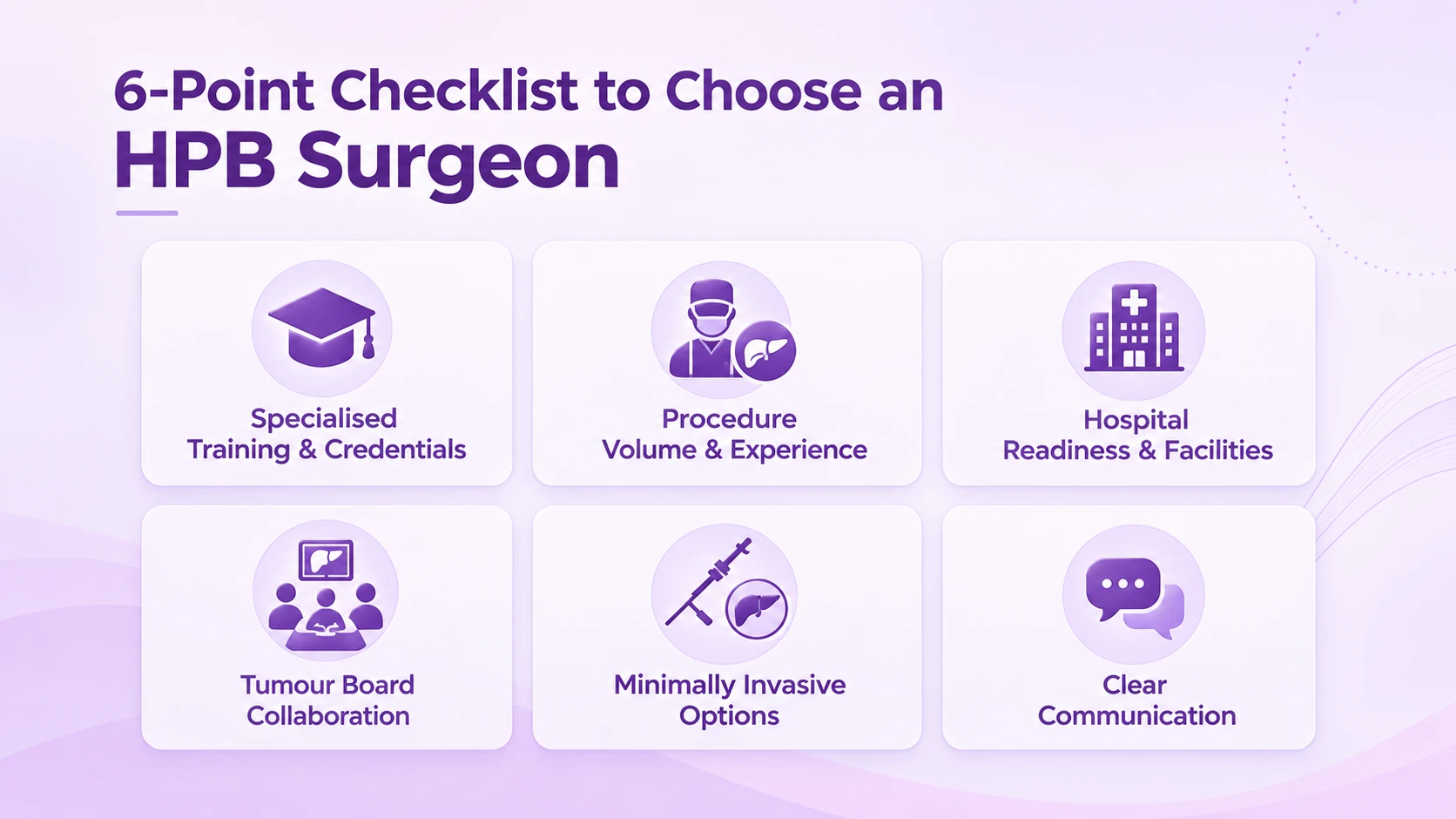
The best HPB surgeon in India for you is one with formal HPB or transplant fellowship training, regular experience in your specific procedure, and a hospital that offers a full multidisciplinary team. Use this checklist when comparing doctors and hospitals.
- Training: an HPB or transplant fellowship and recognised surgical qualifications
- Procedure-specific volume: ask how often the team performs your type of operation each year
- Hospital readiness: transplant ICU, interventional radiology, blood bank and accreditations such as JCI and NABH
- Tumour board: cancer cases should be discussed by surgeons, oncologists and radiologists together
- Minimally invasive options: robotic or laparoscopic surgery where it is safe for your case
- Clear communication: honest answers on risks, recovery, costs and follow-up, with no pressure to decide
A surgeon who welcomes questions and a second opinion is usually one you can trust.
Who Is the Best HPB Surgeon in Delhi NCR?
There is no official ranking, so the best HPB surgeon in Delhi NCR is the one whose training, case experience and hospital support match your condition. Awards and online “top 10” lists do not measure outcomes, which is why the checklist above is more reliable.
- Delhi NCR has several large hospitals with HPB programmes, so compare at least two opinions
- Read each surgeon’s profile for fellowship, years in practice and the procedures actually performed
- Check whether liver transplant is available on site, because complex liver surgery can sometimes need it
- As one example of such a profile, Dr. Abhideep Chaudhary is Chairman and HOD of the Centre for HPB Surgery and Liver Transplantation at BLK-Max Super Speciality Hospital, Delhi
- His credentials include FACS, FRCS, FAIS and a multiorgan transplant surgery fellowship at UPMC, USA, with 20+ years of experience and 2,000+ liver transplants
- He is the President of the Liver Transplantation Society of India (LTSI) and a scientific committee member of the International Liver Transplant Registry
- Patients comparing options can read his background on the Dr. Abhideep Chaudhary profile page and measure it against the checklist
A good choice is one you can verify, so rely on credentials and experience rather than rankings.
Which HPB Conditions Often Need a Specialist Referral?
Liver cancer, pancreatic cancer, bile duct disease and advanced cirrhosis most often need an HPB specialist, because each involves delicate surgery or transplant planning. Where your diagnosis fits, these pages explain the details.
- Liver cancer treatment in Delhi covers resection, ablation and transplant options
- Pancreatic cancer treatment in Delhi explains when the Whipple procedure is considered
- Bile duct surgery is needed for strictures, injuries and bile duct tumours
- Liver cirrhosis and liver failure can lead to a liver transplant evaluation, and infants with biliary atresia need early specialist care
- Robotic liver surgery may suit selected patients who want smaller incisions
An accurate diagnosis comes first, and it decides which specialist should lead your care.
What Happens at Your First HPB Consultation?
At the first visit, the surgeon reviews your history and reports, examines you, may order more tests, and then explains whether you need surgery, other treatment or simple monitoring. You should leave with a clear plan and next steps.
- Bring all scans (CT, MRI, PET) on disc, biopsy reports, blood tests and a list of medicines
- Carry notes from any earlier surgery or procedure
- Write your questions down beforehand, and bring a family member if you can
- Ask about alternatives, recovery time, risks and expected costs; the liver transplant cost guide shows how expenses are usually explained
- If you are unsure, reports can be shared with the team for a second opinion before you decide
Going prepared helps the surgeon give you a faster, more accurate answer.
Final Thoughts
Choosing an HPB surgeon is a decision worth making slowly and with facts. Look at training, procedure-specific experience, hospital support and how openly the team communicates. If you would like a specialist to look at your scans, you can share them with the IHPBLT team for review whenever you feel ready.
References
- World Cancer Research Fund International. Gallbladder cancer statistics (based on GLOBOCAN 2022).
- Birkmeyer JD, Siewers AE, Finlayson EVA, et al. Hospital volume and surgical mortality in the United States. N Engl J Med. 2002;346(15):1128-1137.
- Birkmeyer JD, Stukel TA, Siewers AE, et al. Surgeon volume and operative mortality in the United States. N Engl J Med. 2003;349:2117-2127.

 WhatsApp