

Liver Cancer Awareness Month: Know the Signs, Risks and Screening Options
October is Liver Cancer Awareness Month, a time to learn how liver cancer starts, who is at risk, and why catching it early changes treatment options. Liver cancer often grows silently, so many people discover it late. This guide explains the early signs, causes, screening, and liver cancer treatment options in simple language, with a focus on what Indian patients and families should know.
What Is Liver Cancer Awareness Month and Why Does It Matter?
Liver Cancer Awareness Month is observed every October to raise awareness about liver cancer prevention, early detection, and treatment. It matters because liver cancer is the third-leading cause of cancer death worldwide (AASLD, October 2026), and it is often found only after it has spread.
- GLOBOCAN 2022 recorded about 866,136 new liver cancer cases and 758,725 deaths worldwide.
- Most liver cancers are hepatocellular carcinoma (HCC), which accounts for roughly 80% of primary liver cancers.
- In an Indian tertiary-centre study of 339 patients, 62.4% were already at advanced or end-stage disease (BCLC stage C or D) when diagnosed.
Awareness works because people at risk can be tested long before symptoms appear.
What Are the Early Signs and Symptoms of Liver Cancer?
Early liver cancer usually causes no symptoms. When symptoms do appear, the most common are unexplained weight loss, pain or heaviness in the upper right abdomen, loss of appetite, and yellowing of the skin or eyes (jaundice).
- Unexplained weight loss and constant tiredness
- Dull pain or a lump under the right ribs
- Swollen abdomen (ascites) or swollen legs
- Nausea, early fullness after small meals
- Dark urine, pale stools, or itchy skin
- Sudden worsening in someone who already has cirrhosis
In the same Indian study, 16.8% of patients had no symptoms at diagnosis, which is why waiting for symptoms is risky.
If any of these signs last more than two weeks, especially with a known liver condition, book a liver check-up.
What Causes Liver Cancer and Who Is at Risk?
Liver cancer is mainly caused by long-term liver damage. The biggest risk factors are cirrhosis, chronic hepatitis B or C, fatty liver disease (MASLD), and heavy alcohol use.
- Hepatitis B and C: In India, hepatitis B contributes to about 40-50% of HCC cases and hepatitis C to 12-32% (Tata Memorial Centre, ecancermedicalscience, 2024).
- Fatty liver (MASLD/NAFLD): In the Indian tertiary-centre study above, fatty liver or unknown cause was behind 51% of HCC, now overtaking hepatitis B at some centres.
- Cirrhosis: Seen in 73.2% of the patients in that study. You can read more about managing liver cirrhosis treatment in Delhi NCR.
- Other risks: Alcohol, diabetes, obesity, smoking, family history, and iron-overload conditions.
Fatty liver is now a leading concern in India, so a “silent” liver is no longer only a problem for heavy drinkers. Ask your doctor about liver disease treatment in Delhi if you have diabetes, obesity, or long-standing hepatitis.
Who Should Get Screened for Liver Cancer, and How Often?
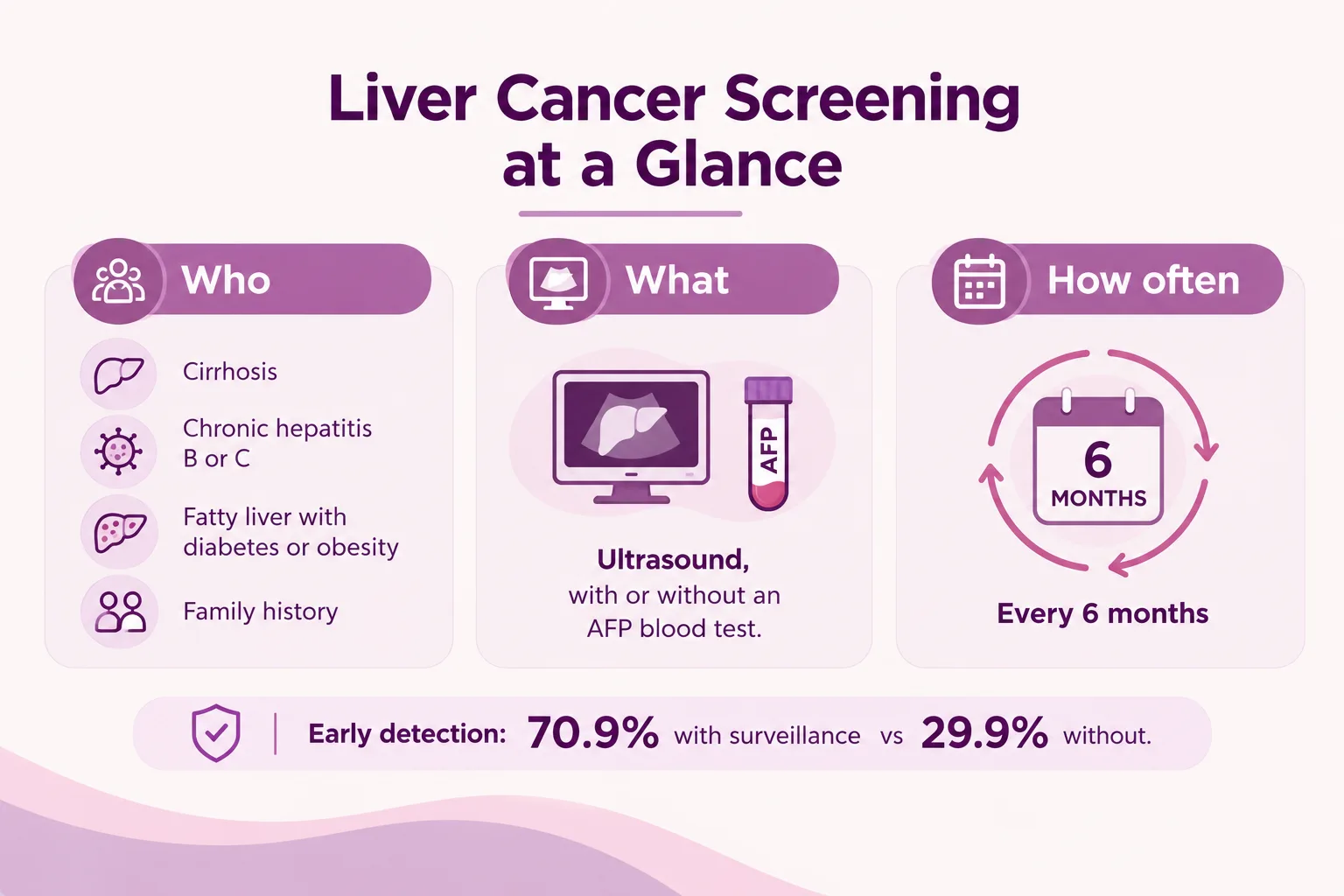
People with cirrhosis or chronic hepatitis B should have a liver ultrasound, with or without an AFP blood test, every six months. This is the recommendation of the AASLD, EASL, and APASL liver societies.
- Screening is for high-risk people, not everyone.
- A pooled analysis of cirrhosis patients (Singal et al., PLoS Medicine) found early detection in 70.9% of those under surveillance versus 29.9% without it.
- Three-year survival was 50.8% with surveillance versus 27.9% without.
- Ultrasound works best at six-month gaps; longer gaps miss more tumours.
Screening is a simple, painless scan, and it is the single best action during this awareness month.
How Is Liver Cancer Diagnosed?
Liver cancer is diagnosed with imaging (ultrasound, triphasic CT, or MRI) and blood tests such as AFP. A biopsy is sometimes needed, but a typical HCC can often be confirmed on scan alone in a person with cirrhosis.
- Imaging: Shows tumour size, number, and blood vessel involvement.
- Blood tests: Liver function, AFP, and viral markers.
- Staging: Doctors use the BCLC system, which looks at tumour burden, liver function, and general health.
- Team review: A liver surgeon, hepatologist, and radiologist plan treatment together.
Staging matters because it decides whether surgery, a transplant, or other treatment is the best fit.
What Are the Liver Cancer Treatment Options?
Treatment depends on tumour size, liver strength, and overall health. Options include surgery to remove the tumour, ablation, embolisation, liver transplant, and drug therapy.
- Liver resection: Removing the tumour and part of the liver, suitable when the remaining liver is healthy enough. Many patients are candidates for minimally invasive robotic liver surgery in Delhi.
- Ablation: Heat or microwave energy destroys small tumours without major surgery.
- TACE/TARE: Treatment delivered through the liver’s blood supply to shrink tumours.
- Liver transplant: Replaces both the cancer and the diseased liver.
- Targeted and immunotherapy drugs: Used when cancer is advanced or cannot be removed.
- Bile duct cancers: Tumours in the bile ducts may need specialised bile duct surgery.
Every plan is personal, so a detailed review at a specialist centre for liver cancer treatment in Delhi is worth the time.
Can a Liver Transplant Cure Liver Cancer?
Yes, for carefully selected patients. A liver transplant can cure early liver cancer in a cirrhotic liver because it removes both the tumour and the diseased liver that caused it.
- Doctors often use the Milan criteria: one tumour up to 5 cm, or up to three tumours of 3 cm or less, with no spread outside the liver.
- Some patients outside these limits may still qualify after treatment shrinks the tumour.
- Living donor transplant can shorten the wait, because a family member can donate part of their liver.
- Recovery and follow-up care are structured, and you can read the full liver transplant in Delhi process and the eligibility criteria for liver transplant.
- Families planning ahead can review the liver transplant cost guide.
A transplant is not right for everyone, but for early disease in a failing liver it offers the best chance of long-term cure.
How Can You Lower Your Risk of Liver Cancer?
You can lower your risk by preventing and treating the conditions that damage the liver. The main steps are hepatitis B vaccination, treating hepatitis B or C, controlling weight and diabetes, and limiting alcohol.
- Get vaccinated against hepatitis B; newborns and adults at risk should complete the course.
- Get tested for hepatitis B and C once. Hepatitis C can be cured with antivirals (see hepatitis C and liver transplant).
- Aim for steady weight loss, regular exercise, and a low-sugar, low-fat diet if you have fatty liver.
- Avoid alcohol if you have any liver disease, and avoid tobacco.
- Avoid unprescribed herbal products and unnecessary painkillers.
Small daily habits protect the liver more than most people expect.
Conclusion
See a liver specialist if you have cirrhosis, chronic hepatitis, fatty liver with diabetes, a family history of liver cancer, or any warning sign that lasts more than two weeks. Early review gives you more treatment choices.
- You have never had a liver scan despite hepatitis B, C, or cirrhosis.
- Your six-monthly scan is overdue.
- A scan shows a liver lesion or your AFP is rising.
- You have been told you need a transplant and want a second opinion.
Dr. Abhideep Chaudhary and the IHPBLT team in Delhi work with patients on liver cancer evaluation, surgery, and transplant planning. This October, take one step: ask whether you are due for a liver scan, and book it.
This article is for awareness and does not replace medical advice. Please consult a qualified doctor for your own situation.
Sources:
- AASLD press release (6 Oct 2026); Li Q. et al.,
- Chinese Medical Journal 2024 (GLOBOCAN 2022); Musunuri B. et al.,
- Indian Journal of Gastroenterology 2022; Tata Memorial Centre, ecancermedicalscience 2024; Singal A. et al.,
- PLoS Medicine 2014; AASLD/EASL/APASL surveillance guidance.

 WhatsApp