

ABO Incompatible Liver Transplant in Delhi
ABO incompatible liver transplant is a procedure in which a donor and a patient with different blood groups can proceed to surgery after careful immune preparation. It can widen donor options when the only willing donor does not match, and it needs planned antibody control, close monitoring and structured follow-up. If you are looking for ABO incompatible liver transplant in Delhi, understanding how the procedure works and what recovery involves can help you prepare for the evaluation.
Dr. Abhideep Chaudhary is a liver transplant and HPB surgeon in Delhi who manages ABO incompatible transplants using planned immune preparation and structured post-transplant monitoring.
What Is an ABO Incompatible Liver Transplant?
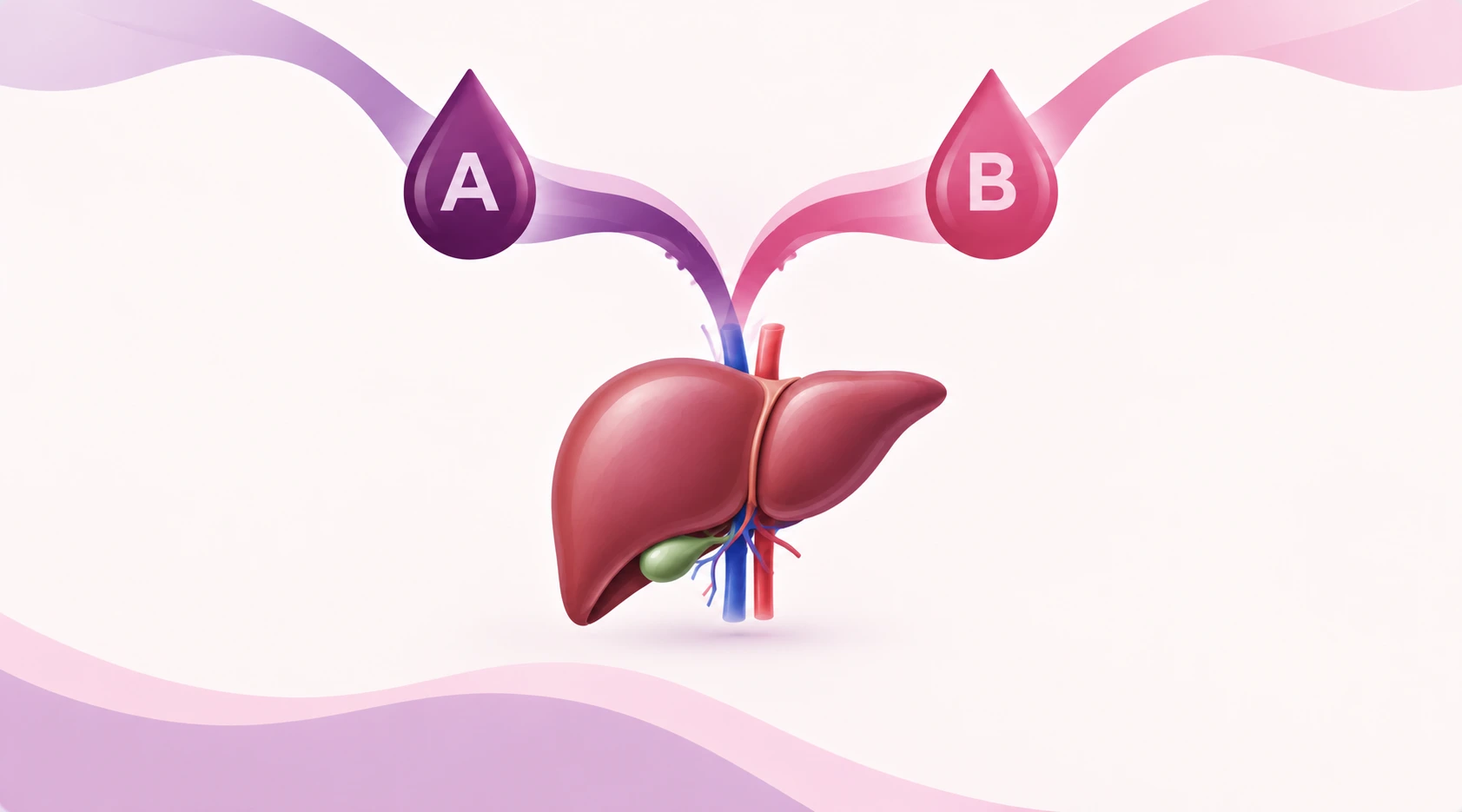
An ABO incompatible (ABOi) liver transplant is a transplant where the donor’s blood group does not match the patient’s. Because the patient’s immune system carries antibodies against the unmatched blood group, doctors first lower those antibodies so the new liver is not attacked.
- Blood groups A, B, AB and O carry different markers (antigens) on cells.
- A person with group O naturally has antibodies against A and B.
- In a mismatch, these antibodies can damage the graft’s blood vessels and bile ducts.
- Treatment before and after surgery keeps antibody levels low.
- Living donor transplant is the main form of liver transplant in India, so ABOi planning usually happens in a living donor setting. (indianpediatrics)
An ABOi transplant is a planned, closely monitored way to cross the blood group barrier, not a shortcut.
Why Is ABO Incompatible Liver Transplant Needed?
It is needed when a patient requires a liver soon but no blood-group-matched donor is available. It widens the donor pool, which matters when liver function is worsening quickly or waiting is risky.
- A willing family donor may simply have a different blood group.
- For many patients with rapidly worsening liver function, or those on a long waiting list, ABOi transplant may be the only option. (NIH)
- Patients with liver cancer can face tumour progression while waiting.
- A paired exchange (swap) with another family is another route, but it depends on a suitable pair being available.
The goal is to give more patients a safe chance at transplant without losing precious time.
Reach Out for Expert Care
How Does ABO Incompatible Liver Transplant Work?
The team measures the patient’s anti-blood-group antibody level (the titre), lowers it with rituximab and plasma exchange, performs the transplant, and then protects the new liver with immunosuppressant medicines and regular titre checks.
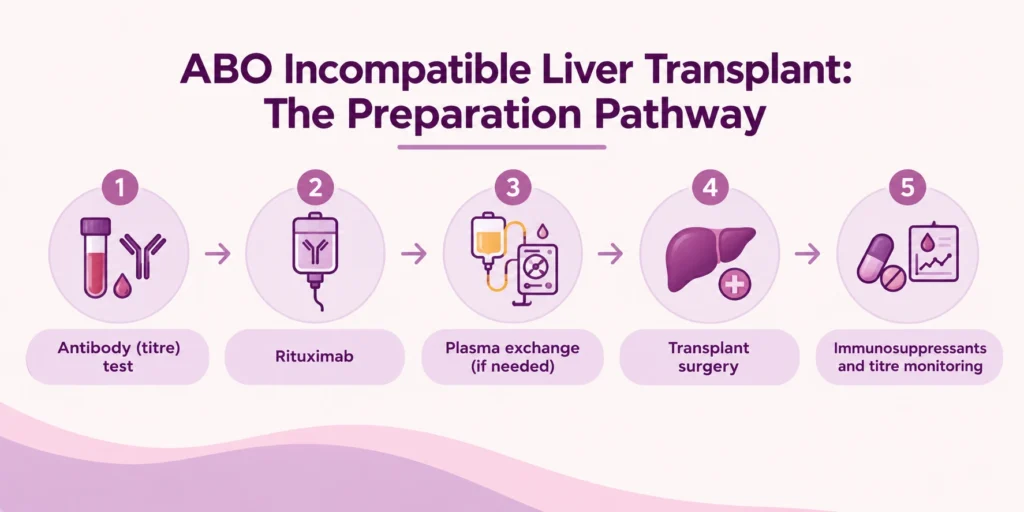
- Antibody testing: a blood test shows how strong the antibodies against the donor’s blood group are.
- Rituximab: this medicine targets the immune cells that make antibodies. In one protocol it was given about three weeks before surgery when titres were high. When titres were low, it was given on the first day after surgery. nihnih
- Plasma exchange (plasmapheresis): antibodies are filtered out of the blood plasma, in one or more sessions.
- Surgery: the operation follows the same steps as any living donor transplant, as described in our step-by-step guide to liver transplantation in Delhi.
- After surgery: tacrolimus, mycophenolate and steroids are common, with frequent titre checks and scans.
Protocols differ between centres, so the plan is tailored to each patient.
Who Is a Suitable Candidate for ABO Incompatible Liver Transplant?
Suitable candidates have end-stage liver disease or liver cancer within transplant limits, antibody levels that are low or can be lowered, and no uncontrolled infection. The transplant team also assesses the donor’s health and liver size.
- General liver transplant eligibility criteria still apply.
- Common reasons include advanced liver cirrhosis and acute liver failure.
- A south Indian series linked higher mortality with a high MELD score, blood group O and more intense desensitisation, so these factors are weighed carefully.
- Living donors are assessed under Indian transplant law, including authorisation committee review.
- Our note on selecting patients for ABO incompatible transplant explains the process in more depth.
Suitability is always decided case by case after a full evaluation.
What Is the Success Rate of ABO Incompatible Liver Transplant?
Since rituximab became standard, adult survival after ABOi living donor transplant has been similar to matched transplant in published studies. In one study of 46 ABOi and 340 matched adult transplants, five-year survival was about 71% in both groups.
- One-, three- and five-year survival was 81.7%, 75.7% and 71.0% for ABOi recipients, against 81.0%, 75.2% and 71.5% for matched recipients. (NIH)
- A Japanese national survey found three-year survival rose from about 30% to about 80% after rituximab was introduced. (NIH)
- A meta-analysis found no significant difference in one-, three- and five-year survival between ABOi and matched groups. (DOAJ)
- These are results from specific centres and cannot be promised for any individual patient.
Outcomes depend on the patient’s condition and the team’s experience, not on blood group alone.
What Are the Risks and Complications?
The main extra risks are antibody-mediated rejection, bile duct (biliary) complications, and infections linked to stronger immune suppression. Most can be monitored and treated, but they demand close follow-up.
- Biliary complications occurred in 50.0% of ABOi recipients versus 29.7% of matched recipients in the Korean study above. (NIH)
- Biliary complications, CMV infection and antibody-mediated rejection remain concerns even in the rituximab era. (DOAJ)
- An Indian centre reduced its rituximab and plasma exchange intensity after early deaths from resistant infections. (Amrita)
- General surgical risks (bleeding, clots, infection) are covered in our guide to liver transplant risks and complications.
Knowing these risks early helps families prepare and helps the team watch for problems sooner.
What Is Recovery Like After ABO Incompatible Liver Transplant?
Recovery resembles other liver transplants: an ICU stay, a hospital stay of a few weeks, then regular follow-up. ABOi patients get extra antibody monitoring in the early weeks.
- In one Indian paediatric series, the average ICU stay was about 7 days and the hospital stay about 19 days. Adult stays vary. indianpediatrics
- Immunosuppressant tablets are taken long term, with dose changes guided by blood tests.
- Scans and liver function tests are frequent in the first months.
- Infection precautions, diet and follow-up schedules are outlined in life after liver transplant.
Most patients return to daily routines gradually as the new liver settles.
Is ABO Incompatible Liver Transplant Possible in Children?
Yes, children can undergo ABOi liver transplant. Infants have naturally low anti-blood-group antibodies, so blood group mismatch is often easier to manage in very young children than in adults.
- Survival in infants has been better than in adults in Japanese registry reports. (NIH)
- At one Gurgaon centre, 8 of 203 paediatric liver transplants (2011–2018) were ABO incompatible, managed with plasmapheresis and close monitoring. (Indianpediatrics)
- Family donors are common; see living donor liver transplant for children.
- Our pages on paediatric liver transplant in Delhi and ABO incompatible transplant in children go deeper.
A child’s age and antibody levels guide how much preparation is needed.
Reach Out for Expert Care
How Much Does ABO Incompatible Liver Transplant Cost in India?
It usually costs more than a matched transplant because of added medicines, plasma exchange sessions, antibody tests and closer monitoring. The final amount depends on the hospital, donor evaluation, and length of stay.
- Rituximab and plasma exchange add to treatment cost.
- Longer monitoring and repeat tests raise follow-up costs.
- Complications, if they occur, can extend the stay.
- Our overview of liver transplant cost explains the main cost components.
Families can ask for an itemised estimate during evaluation to plan with clarity.
From Pittsburgh to Delhi: The Training Behind ABO Incompatible Liver Transplant in Delhi
Dr. Abhideep Chaudhary is a liver transplant and HPB surgeon in Delhi. He trained in General Surgery (MS) and completed a hepatobiliary and multiorgan transplant fellowship at the Thomas Starzl Transplantation Institute, University of Pittsburgh Medical Center. His approach to blood group mismatch focuses on safe antibody control, careful patient selection and structured follow-up.
His expertise includes:
- Living donor liver transplant, including ABO incompatible cases.
- Paediatric liver transplant.
- Liver, pancreatic and bile duct diseases.
- Minimally invasive liver and HPB surgery.
- Individualised planning based on antibody levels, liver disease and donor suitability.
If you are looking for a liver transplant surgeon in Delhi for a blood group mismatch, these are the points worth keeping in mind. Look for transplant fellowship training, a written protocol for rituximab, plasma exchange and titre monitoring, and a full team of hepatology, transplant anaesthesia, intensive care and blood bank specialists
Consultation for ABO Incompatible Liver Transplant in Delhi: What to Prepare?
A first consultation works best when you bring your records, blood group reports for the patient and each willing donor, recent test results and a list of questions. This helps the team judge feasibility, antibody risk and timing in one visit.
Before the consultation, keep these ready:
- Blood group reports for the patient and every potential donor.
- Recent liver function tests, INR, creatinine, and ultrasound, CT or MRI reports.
- Earlier discharge summaries, biopsy or endoscopy reports, and a list of current medicines and allergies.
- For liver cancer, the latest scans and AFP reports.
- Identity and relationship documents for donors, which are needed for legal authorisation.
- Questions to ask: how often the team manages blood group mismatches, which protocol they follow, how infections are prevented, what the follow-up schedule is, and what an itemised cost estimate includes.
If you are searching for a liver transplant specialist in Delhi NCR, these details help you compare options clearly. Patients and families can discuss the diagnosis, donor options and recovery plan during a consultation, at their own pace.
Sources:
- Medicine (Baltimore) 2015;94(42):e1796
- Gastroenterol Res Pract 2019 (Yadav et al., meta-analysis)
- Immunologic strategies in ABO-I LDLT (PMC6940481);
- Indian J Gastroenterol 2019;38(1):23–28;
- Indian J Gastroenterol 2014;33(1):72–76;
- Indian Pediatr 2021;58:281–282.
FAQs
Senior liver specialist with extensive experience in transplant and complex liver care.
Can a liver transplant be done if the donor and patient have different blood groups? expand_more
Yes, in selected patients. The team first lowers the patient’s antibodies against the donor’s blood group using medicines and plasma exchange, then monitors antibody levels closely after surgery.
Is ABO incompatible liver transplant as safe as a matched transplant? expand_more
In adults treated with modern protocols, published studies show survival rates similar to matched transplants. Some risks, such as bile duct complications and infection, can be higher, so close follow-up matters. Individual results depend on the patient’s condition.
Who can be a donor in an ABO incompatible liver transplant? expand_more
A healthy adult family member, usually a near relative, who passes the donor evaluation and legal authorisation. The donor’s blood group does not need to match the patient’s.
Does ABO incompatible liver transplant cost more than a matched transplant? expand_more
It often does, because of extra medicines, plasma exchange sessions, antibody tests and longer monitoring. The total depends on the hospital, the protocol and the length of stay, so an itemised estimate is useful.
Is ABO incompatible liver transplant possible for children? expand_more
Yes. Infants naturally have low blood group antibodies, so a mismatch is often easier to manage in very young children. Older children may need the same preparation steps as adults.

Medically Reviewed by:
The IHPBLT Medical Editorial Team
 WhatsApp